Published-release documentation · release compatibility
Point Appearance
encodeRadius({ value, target? })
Broadcast a non-negative finite graphical radius to a point mark.
Contextual fragment. Use an ES module with the imports, data, and prepared resource state described in this section. Caller-provided receivers:
program. Resolve these names from setup in this fragment or section; alternatives branch from the same base.
program.encodeRadius({ value: 3 });
encodePointRadius({ value, target? }) is available in default and Basic entries.
Scatter point.radius delegates to it and conflicts with top-level size.
The older encodeRadius alias and removePointRadius remain default-entry APIs.
It records encodeRadius as a wrapped child and remains distinct from
encodeR, which assigns semantic radial position.
| Option | Type | Default |
|---|---|---|
value |
non-negative finite number | required |
target |
point mark ID | current mark |
Radius is fixed appearance. It does not create a semantic field encoding and is not a Polar radial position channel.
removePointRadius({ target? } = {})
Contextual fragment. Use an ES module with the imports, data, and prepared resource state described in this section. Caller-provided receivers:
program. Resolve these names from setup in this fragment or section; alternatives branch from the same base.
const defaultSized = program.removePointRadius();
The point must have an explicit constant radius. The action removes that
graphical config and rematerializes every glyph at the theme radius 3; it
does not remove or edit semantic Polar radius. An ambiguous target or a point
without an explicit radius is an error.
Point field encodings
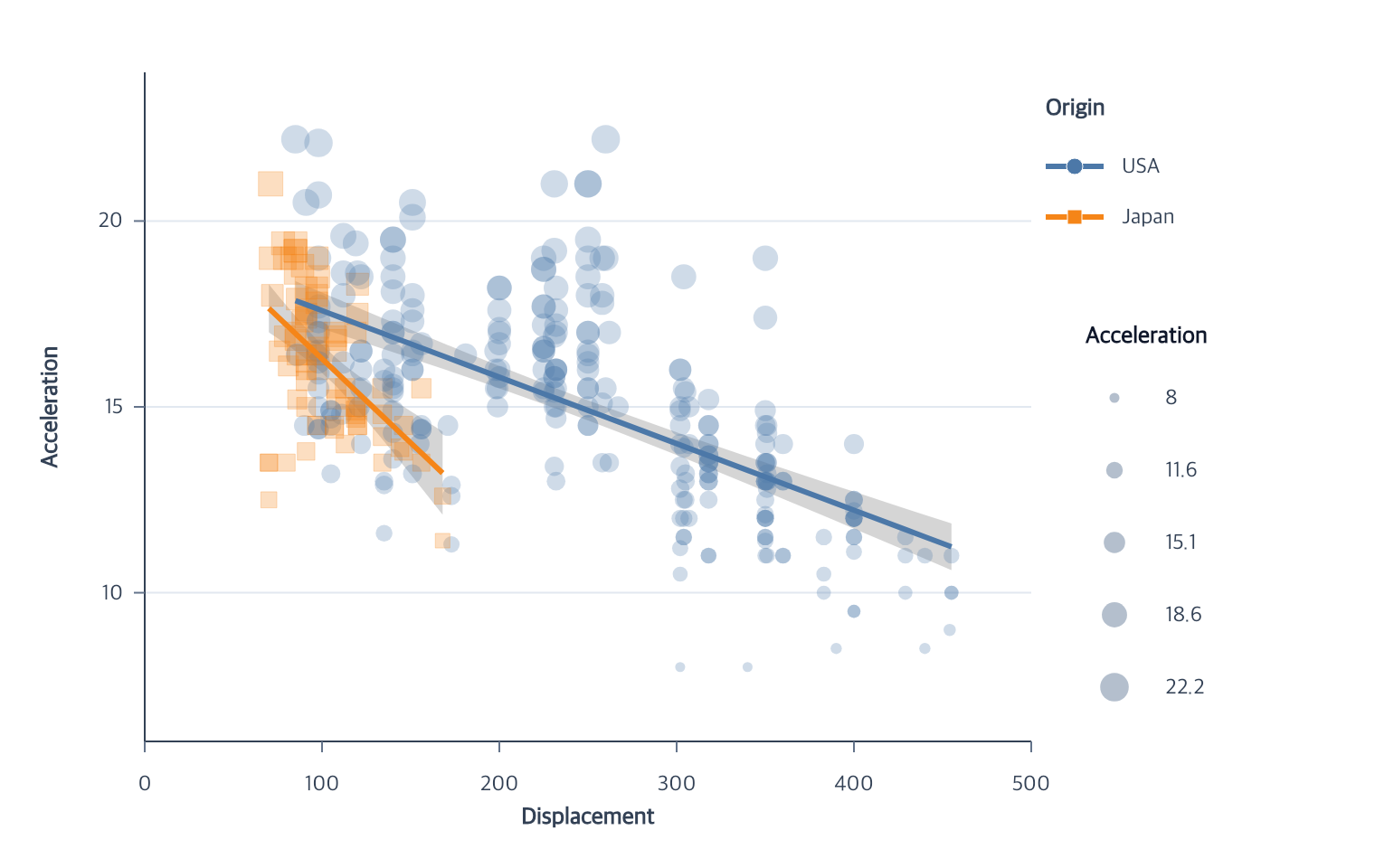
Contextual fragment. Use an ES module with the imports, data, and prepared resource state described in this section. Resolve these names from setup in this fragment or section; alternatives branch from the same base.
program
  .encodeSize({ field: "Acceleration" })
  .encodeShape({ field: "Origin" })
  .encodeOpacity({ value: 0.27 });
encodeSize({ field, target?, fieldType?, scale? }) requires a quantitative
field. Its scale supports linear, log, sqrt, pow, quantize, quantile,
and threshold. Every range value is an area in square logical pixels; the
automatic continuous range is [24, 196]. Circles use sqrt(area / PI) as
radius and squares use sqrt(area) as side length, so the shapes represent
equal visual area. Explicit polygons use the same area normalization by default;
normalization: "radius" instead
interprets size as reference-circle area.
Logarithmic size scales require positive values and use base 10 unless base
is supplied. Square-root and power scales require non-negative values; power
scales require a positive exponent. Quantize and quantile require at least two
nondecreasing area values. Threshold domains are strictly increasing cut points
and require one more area than cuts. Discrete size legends show every interval
and therefore reject an explicit sample count.
encodeShape({ field, target?, fieldType?, scale? }) requires a nominal field.
Its ordinal scale accepts the fourteen named point shapes and explicit simple
polygons documented under Point marks. The automatic range
uses each named shape once and rejects more than fourteen categories. Explicit
ranges may repeat supported shapes deliberately and must cover the domain;
there is no implicit cycling. Explicit unknown accepts a named or polygon
fallback without adding it to the domain or legend. Mixed circle, rect, and
closed-path symbols are stored as typed items in one graphical collection.
encodeOpacity accepts exactly one of value or field. A constant value from
0 to 1 is graphical. A quantitative field creates semantic opacity and a
linear scale with automatic range [0.2, 1]; its scale supports explicit
domain/range plus nice, zero, clamp, and reverse. Calling the action
again atomically replaces constant↔field or field↔field mode. Every resolved
opacity remains concrete in graphicSpec. editPointMark({ opacity }) rejects
active field opacity; explicitly call encodeOpacity({ value }) to replace it.
All point appearance actions invoke the same point materializer. Existing x, y, color, size, shape, and opacity state is recombined after each change and after Canvas bounds change, making action order irrelevant.
Calling encodeSize or encodeShape again replaces its existing field and
compatible scale binding. Omitting scale.id reuses the current scale;
providing a new ID retains the previous named scale. Existing legends are
recomputed, inferred legend titles follow the new field, and explicit legend
titles and styles remain unchanged.
Related
Appearance overview · Point marks · Legends
Documentation provenance
293 actions · sha256:e755591a2e5f5e2b494867583876e28020a478c5220b77bdc6ad469a6224891d