Published-release documentation · release compatibility
Ordinal and Stroke Dash Scales
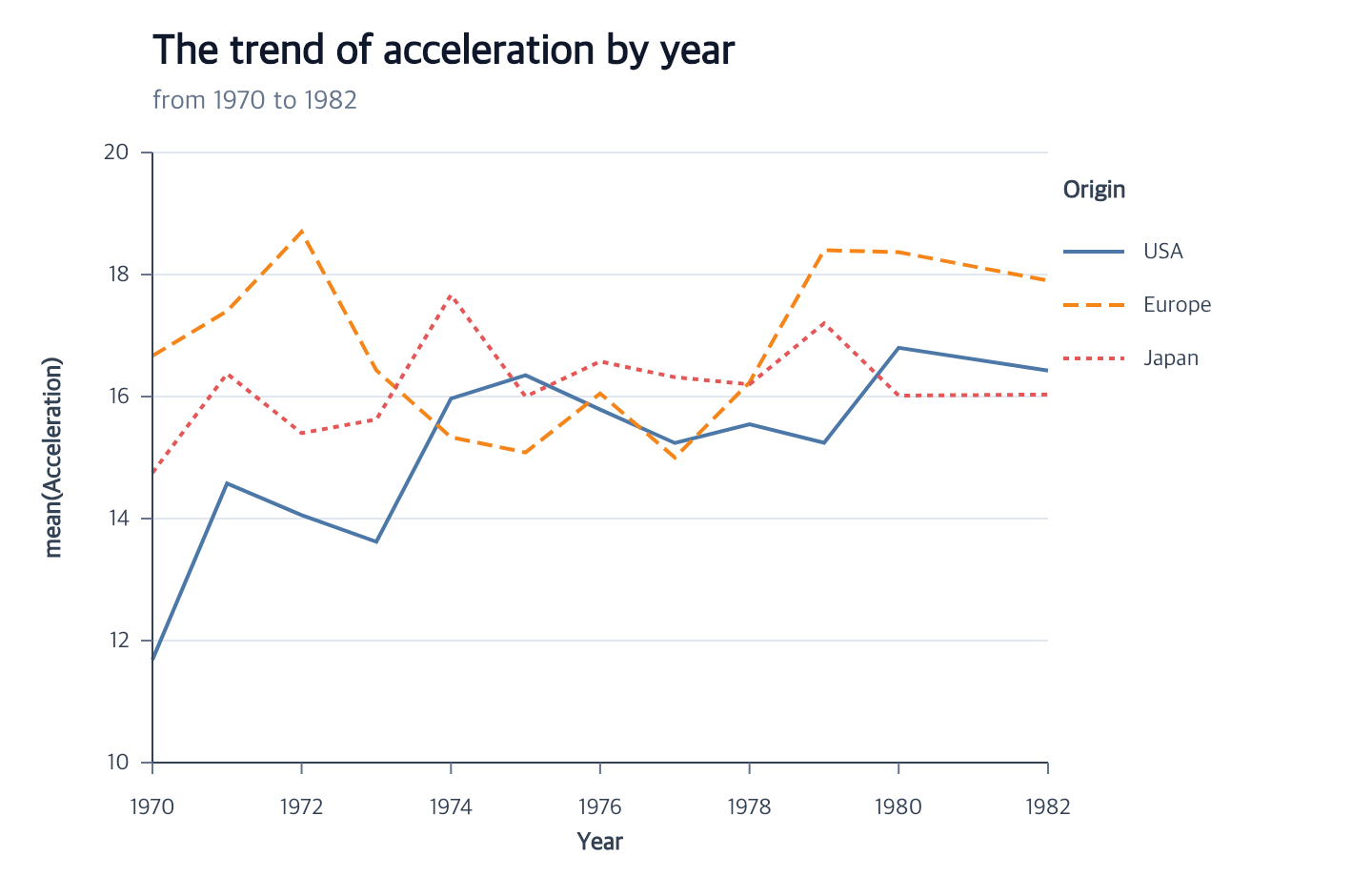
Discrete and ordinal scales
Band/point position, color, and stroke-dash encodings use ordered discrete
domains. Automatic domains preserve first-appearance order. ordinal remains
the appearance and offset lookup type; position uses explicit band or point.
Color and stroke-dash accept nominal and ordinal fields. Ordinal preserves
ordered categorical intent; it does not sort rows or turn numeric categories
into a continuous mapping. Explicit domain order takes precedence.
A band or point position scale uses "auto" or a numeric pair as its range.
Automatic ranges use the plot bounds. Resolved band scales record signed
step, aligned start, and positive bandwidth; point scales record the same
geometry with zero bandwidth. Marks, ticks, labels, and grids read the same
resolved centers. Reversed explicit ranges are valid.
Color ranges accept explicit colors or a named palette descriptor; stroke-dash ranges accept named styles and direct dash patterns. Shape ranges and unknown fallbacks accept named shapes or explicit simple polygons, including their area or radius normalization policy. Automatic shape ranges retain the fourteen named shapes; custom polygons require an explicit range.
Contextual fragment. Use an ES module with the imports, data, and prepared resource state described in this section. Caller-provided receivers:
program. Resolve these names from setup in this fragment or section; alternatives branch from the same base.
program.encodeColor({
  field: "Origin",
  scale: {
    domain: ["USA", "Europe", "Japan"],
    range: ["#4c78a8", "#f58518", "#e45756"]
  }
});
User-specified domains and ranges are semantic state. Resolved coordinates, colors, and dash patterns are stored as concrete graphical values.
Stroke-dash ranges
The names solid, dashed, dotted, and dashdot resolve to [], [6, 4],
[1, 3], and [6, 3, 1, 3]. A direct pattern is an empty array or an
even-length array of non-negative finite numbers that is not entirely zero.
Contextual fragment. Use an ES module with the imports, data, and prepared resource state described in this section. Caller-provided receivers:
program. Resolve these names from setup in this fragment or section; alternatives branch from the same base.
program.encodeStrokeDash({
  field: "Origin",
  scale: { range: ["solid", "dashed", [8, 3]] }
});
Semantic scale state preserves the names; the resolved scale, line paths, and legend symbols contain numeric patterns only. Pattern lengths use logical Canvas units and do not change with output pixel ratio.
Categories outside a fixed domain
Set scale.unknown to a named style or direct pattern for valid categories
outside the domain of a Cartesian line or rule. [] draws a solid stroke.
The fallback never becomes a domain or legend entry, and different raw
categories remain distinct line series. Missing or malformed categories still
fail. Omitting the option retains strict domain checking. An automatic domain
continues to include the original categories in first-appearance order.
Use editStrokeDashScale({ unknown: "dotted" }) to replace the fallback.
Omission retains it; explicit unknown: undefined removes it. Removal fails
atomically while any consumer still has an out-of-domain category. Parallel,
polar, aggregate and binned path topologies do not support this fallback.
Related
Scale overview · Encodings · Troubleshooting
Documentation provenance
293 actions · sha256:e755591a2e5f5e2b494867583876e28020a478c5220b77bdc6ad469a6224891d