Published-release documentation · 281 actions; release compatibility · contract 5520b0fa9525
Data Grain and Statistical Policies
Choose a transform by its output meaning before selecting a chart. Aggregation, completion, and imputation solve different problems and do not share one missing-value or weight policy.
Compare input and output grain
| Family | Input and ordering | Output grain | Missing, empty, and weighting policy |
|---|---|---|---|
| Summary | Raw rows; groups in first appearance | One row per observed group | Ungrouped empty input yields one aggregate row; grouped empty input yields none. Aggregate operation controls valid/missing/count semantics; weighted operations validate values and weights before grouping. |
| Bin | Finite quantitative observations and one boundary policy | One row per retained interval | Empty bins retained by default; frequency/reliability mass is supported; explicit bounds must contain values. |
| Rectangular 2D bin | Two finite quantitative fields | One row per retained rectangular cell | Explicit include-empty policy; weighted/adaptive/hexagonal bins are unsupported. |
| Fold | Ordered fields of one primitive type | Source row × selected field | Missing and mixed-type cells reject; original fields remain. |
| Computed | Serializable expression over each row | Same rows with a new scalar field | A present undefined cell becomes null; an absent field name rejects. Branches are structurally checked even when short-circuited. |
| Normalize | Per-group calculations; baseline methods need stable ordering or an explicit value | Same rows in source order | Finite numeric input; zero denominator rejects unless an explicit null/zero policy applies. Share rejects negative input. |
| Complete | At most one row per observed group/key; explicit or observed key domain | Observed group × key domain | Adds synthetic rows with null/fill cells; no Cartesian expansion of unrelated grouping values. Empty grouped input creates no groups. |
| Impute | Existing rows, groups, and method-specific stable order | Same rows in source order | Fills null/undefined only. Linear uses numeric/time distance. Edges and max-gap are explicit policies; NaN/infinity reject. |
| Stack | Unique category/group pairs | Same rows plus endpoints and share | No missing-cell synthesis. Stack/fill/center require nonnegative values; diverging separates signs; zero has zero share. |
| Window | Explicit sort/partition decisions for ordered operations | Same rows in source order | Stable ordering governs windows; frame and per-operation rules determine edges. No rows are synthesized. |
| Sorted data | Ordered keys with explicit direction, null placement, and optional temporal normalization | Same rows in stable sorted order | Equal keys retain source order. Mixed non-missing key types reject instead of coercing values. Sorting never mutates the source rows. |
| Time unit | Explicit temporal parsing and calendar policy | Same rows with a bucket field | UTC by default or an explicit IANA zone; weekday is categorical, other buckets are timestamps. |
| Density | Finite observations; optional group and bandwidth | Ordered sample grid per group | Positive mass contributes; zero weights are validated but omitted from statistical membership. Kernel, extent, and normalization are explicit. |
| ECDF | Ordered finite support within groups | One initial seed plus each positive-mass support | Missing defaults to drop; explicit error available. Zero weight adds no support; negative/nonfinite weight or zero total mass rejects. |
| Regression / interval | Compatible finite numeric measurements and method-specific groups | Fit samples or one interval per group | Explicit missing: "drop" | "error" controls nullable rows. Fitting and uncertainty have separate sample requirements; interval: false computes no interval fields. |
Summary, bin, density, regression, and interval transforms record exclusion reports
under materializationConfigs.calculations. The report identifies the current logical
owner, input and retained counts, excluded reasons, and the units used by weighted
calculations. Editing or revising a transform replaces its report with one computed
from the current input; removing the owner removes the report.
Missing keys are not missing values
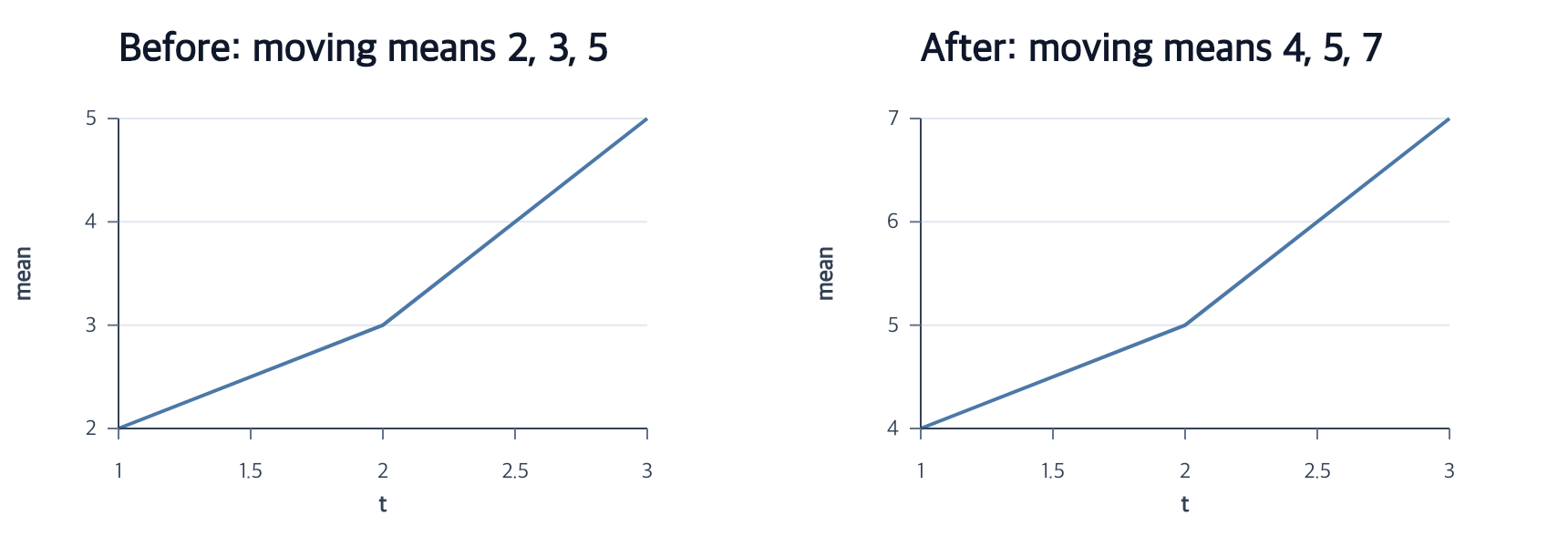
The complete repair workflow starts
with (1,2) and (3,6). Its row counts are 2 → 3 → 3 → 3:
| Stage | Values at keys 1, 2, 3 | Meaning |
|---|---|---|
| Source | 2, absent, 6 | There is no row for key 2 |
| Complete | 2, null, 6 | A row was added; absence was not silently changed to zero |
| Linear impute | 2, 4, 6 | A finite interpolated measure was assigned |
| Trailing mean, preceding 1 | 2, 3, 5 | Each value summarizes the current and previous row |
Weights, units, and finite density extents
Frequency weights are non-negative safe integer multiplicities. Reliability weights are non-negative finite values with effective-sample-size rules for sample statistics. Supported weighted actions validate even zero-weight rows. A weight is not a visual opacity or glyph-size channel. The weighted comparison shows mass, density, and cumulative probability in separate panels.
KDE normalization:"unit" scales the underlying density to unit mass. Drawing a
finite extent only shows part of that function, so its sampled trapezoidal area need
not equal one. normalization:"count" uses count or weighted mass. Neither mode
turns each displayed y value into a cumulative probability.
Calendar bucketing in an IANA zone and elapsed-time windows also differ: local dates can cross daylight-saving changes, while timestamps measure elapsed milliseconds. Choose the time-unit policy for calendar grouping and the window operation for the ordered calculation; do not infer a fixed 24-hour duration from a local date label.
Related
Data overview · Authoring conventions · Weighted distributions